
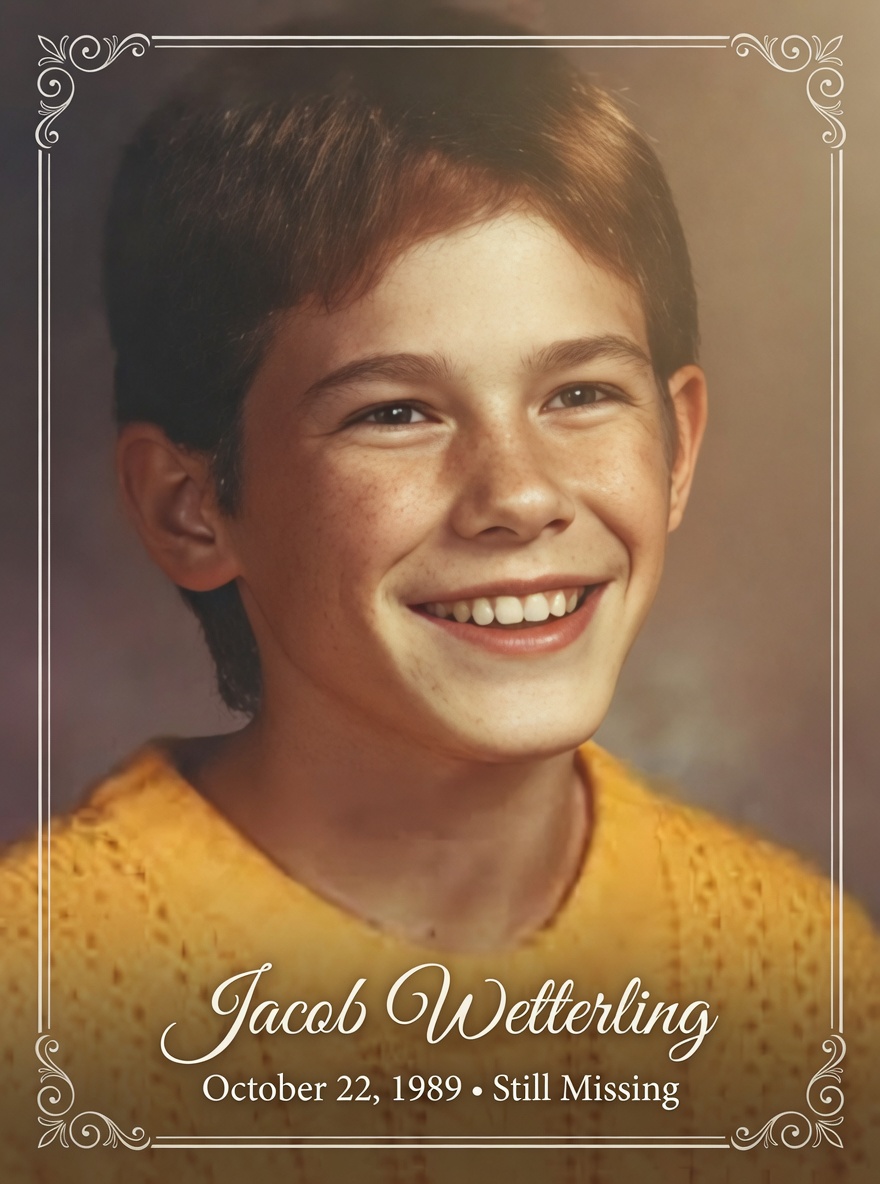
On September 1, 2016, investigators searching a rural pasture near Paynesville, Minnesota, uncovered human bones buried beneath the soil. For a case that had haunted a family, a community, and an entire nation for nearly three decades, the discovery marked the beginning of long-awaited answers. Two days later, forensic testing confirmed the devastating truth: the remains belonged to Jacob Wetterling, the 11-year-old boy abducted in 1989.
Jacob’s case was no longer a mystery — but the pain of what had been lost could never be undone.
The Disappearance That Shattered a Community
On the evening of October 22, 1989, Jacob Wetterling was riding his bike home in St. Joseph, Minnesota, alongside his younger brother Trevor and a family friend. Just a short distance from home, their ride was interrupted by a masked gunman who emerged from the darkness.
The man ordered the boys into a ditch and demanded they lie face down. After questioning them, he released two — but took Jacob with him. The abductor disappeared into the night, leaving behind a scene that would forever change the lives of everyone involved.
Jacob was 11 years old.
Within hours, a massive search effort began. Law enforcement, volunteers, and neighbors combed fields, woods, and roads. Flyers were printed. Tip lines were flooded. But Jacob was never found.
Years Turn Into Decades
As days turned into months, and months into years, Jacob’s disappearance became one of the most widely known missing-child cases in the United States. Despite countless tips and suspects, investigators were unable to identify the person responsible.
The uncertainty was relentless. Jacob’s parents, Patty and Jerry Wetterling, lived with unanswered questions for decades — never knowing where their son was, whether he was alive, or what had happened to him.
For the community of St. Joseph, the case became a permanent scar. Children grew up hearing Jacob’s name. Parents became more cautious. Trust was altered.
Jacob’s disappearance also occurred at a time when missing children cases were not handled with the urgency and coordination seen today — something that would later change because of his story.
A Break in the Case
In October 2015, nearly 26 years after Jacob was abducted, authorities publicly named Danny James Heinrich as a person of interest. Heinrich had lived near the area at the time of the crime and had long been known to investigators, but no charges had ever been brought.
The announcement reignited national attention and brought renewed hope that answers might finally come.
That hope became reality in 2016, when Heinrich entered a plea agreement related to an unrelated child pornography case. As part of the agreement, he confessed to abducting and killing Jacob Wetterling and revealed where Jacob had been buried.
The location — a pasture near Paynesville — was not far from where Jacob had been taken decades earlier.
Discovery and Confirmation
On September 1, 2016, investigators recovered human remains from the site Heinrich identified. Two days later, DNA testing confirmed that the remains belonged to Jacob.
For Jacob’s family, the confirmation was devastating — but it also ended nearly three decades of not knowing. The waiting, the uncertainty, and the endless questions had finally reached an answer, even if it was the one they had long feared.
In public statements, the Wetterling family expressed both heartbreak and relief — relief that Jacob had been found and could finally be brought home.
Impact Beyond One Case
Jacob Wetterling’s case did more than capture national attention — it permanently reshaped how missing children cases are handled in the United States.
His mother, Patty Wetterling, became one of the country’s most prominent child-safety advocates. She worked tirelessly to raise awareness about child abduction prevention and helped influence national policy.
Jacob’s case contributed to:
- Faster response protocols for missing children
- Increased public awareness and education programs
- Improved coordination between local, state, and federal law enforcement
- The foundation for organizations dedicated to child safety and recovery
His disappearance exposed weaknesses in investigative systems — and his legacy helped fix them.
Closure, But Not an Ending
The discovery of Jacob’s remains in 2016 brought closure in one sense — but it did not erase the years of loss. Jacob’s childhood was stolen. His family lived decades without answers. A community was forever changed.
Yet, Jacob’s life left an enduring mark. His name is spoken not only in remembrance, but in purpose — a reminder of why child safety matters, why investigations must never stop, and why every missing child deserves relentless effort.
Nearly 27 years after he was taken, Jacob Wetterling was finally brought home.
His story remains one of the most significant and heartbreaking cases in American history — not only for what was lost, but for how deeply it changed the way a nation protects its children.

Dome, creator of Meaningmint, turns everyday words into powerful meanings. His mission? Make knowledge refreshing, just like mint.