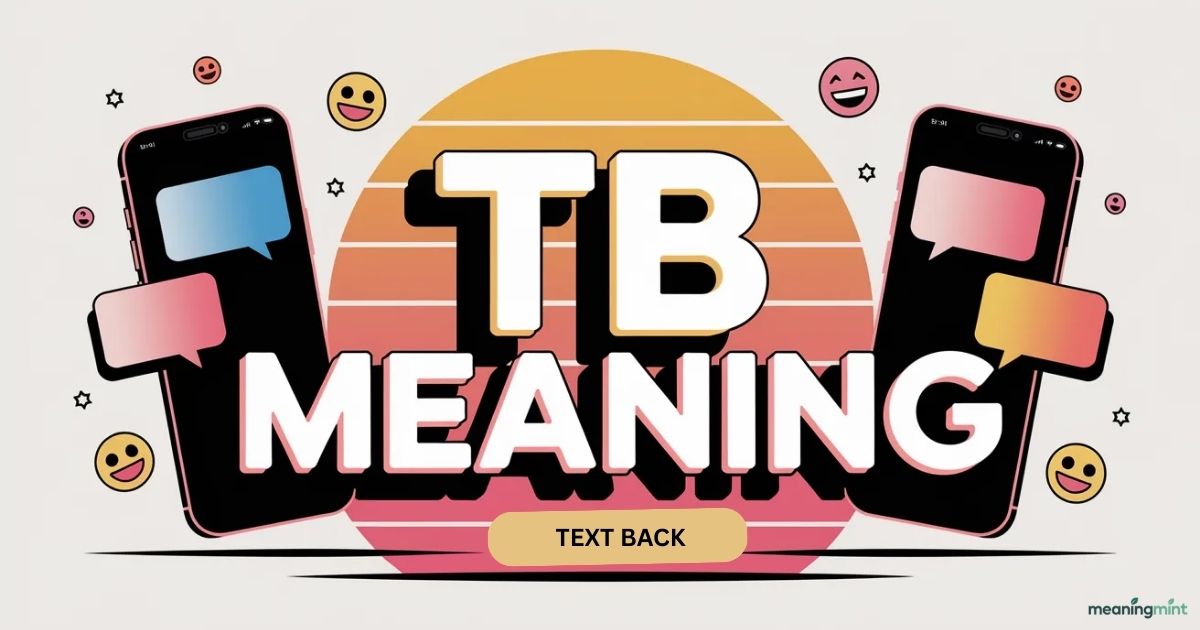
Understanding tb meaning in text is more useful than it sounds — two tiny letters carry surprisingly different messages depending on who sends them, when, and why.
If you’ve ever stared at your phone wondering what does tb mean in text, you’re not alone. This guide breaks down every tb meaning text, from tb meaning slang like “text back” to nostalgic throwbacks, covering every angle of tb slang meaning clearly and simply.
What Does “TB” Mean in Text Messages?
“TB” is one of those two-letter abbreviations that seems simple but carries surprisingly different meanings depending on where, how, and who sends it. Like most text slang, it lives and dies by context — the same letters in a different conversation can mean something completely different.
Text Back (The Most Common in Messaging)
When someone sends you “TB,” they almost always want you to reply. It’s a casual nudge used between friends, partners, or anyone waiting on a response. It can feel friendly or slightly pushy depending on the tone, but at its core it simply means “respond to me when you get a chance.”
Examples:
- “Hey haven’t heard from you, TB when you’re free”
- “TB asap, it’s important”
- “No rush but TB later 😊”
Throwback (Social Media / Nostalgic Usage)
On platforms like Instagram, Snapchat, or Twitter, “TB” is shorthand for Throwback — referring to old photos, memories, or moments from the past. You’ll usually spot it in captions or comments when someone shares something nostalgic, often paired with TBT (Throwback Thursday).
Examples:
- “TB to summer 2019 😭🔥”
- “TB when we had no worries lol”
Talking ‘Bout / Talking About
In fast, casual texting — especially in younger or urban slang — “TB” can mean “talking about” or “talking ’bout.” It’s used mid-sentence to reference whatever someone is discussing, and it flows naturally in quick back-and-forth conversations where full words feel unnecessarily slow.
Other Meanings & Non-Slang Uses
Outside of everyday texting, “TB” carries completely different meanings in professional and medical contexts. It’s widely recognized as the abbreviation for tuberculosis in healthcare, terabyte in tech, and can even represent a name or brand initial. Context is everything here.
| Context | TB Means |
| Medical | Tuberculosis |
| Tech | Terabyte |
| Finance/Business | To Be (confirmed) |
| Sports | Tight Back / Tom Brady (fan slang) |
ALSO READ: JS Meaning in Chat: Full Form, Usage & Psychology Guide 2026
Tone and Context: Why They Change Everything
The exact same “TB” can feel warm, rude, urgent, or casual based entirely on the situation surrounding it. Two people can receive identical messages and walk away with totally opposite impressions. Reading tone in text is a skill — and “TB” is a perfect example of why that skill matters.
Polite vs Impatient
A polite “TB!” reads like a gentle reminder, almost like a soft knock on a door. An impatient one reads like someone tapping their foot. The words are identical — what shifts the feeling is everything around them: capitalization, punctuation, and whether there was already a missed message before it.
Examples:
- Polite → “TB whenever you’re free, no rush! 😊”
- Impatient → “TB.” or “TB??” or “Why haven’t you TB’d yet”
Formal vs Casual Settings
“TB” has almost no place in formal or professional communication. Sending it to a boss, client, or teacher would likely read as unprofessional or confusing. In casual friendships or romantic texting, though, it fits perfectly — it’s breezy, quick, and signals a relaxed dynamic between two people who know each other well.
Punctuation & Emojis Matter
A single punctuation mark or emoji completely changes the emotional weight of “TB.” This is one of the clearest examples in modern texting where what you don’t write matters just as much as what you do. Readers constantly decode these tiny signals — often without even realizing it.
| Version | Vibe |
| “TB 😊” | Friendly, warm |
| “TB!” | Upbeat, casual |
| “TB.” | Cold, slightly passive-aggressive |
| “TB??” | Frustrated, impatient |
| “TB when u can 💕” | Affectionate, close relationship |
Timing / Delays
If someone sends “TB” five minutes after their last message, it’s a gentle follow-up. If it comes two days later with no context, it lands very differently — loaded with unspoken frustration or concern. The gap between messages quietly rewrites the emotional meaning of those two letters before the reader even finishes processing them.
Relationship Factor
Who sends “TB” matters just as much as how they send it. A best friend saying it feels normal. A crush saying it feels loaded. A stranger saying it feels odd. The closer the relationship, the more naturally “TB” fits — and the more latitude both people have to interpret it without overthinking the message behind it.
How to Reply to “TB” Texts: Polite, Casual & Professional Examples
When someone sends you “TB,” they’re waiting on you — and how you respond sets the entire tone of the conversation. Whether it’s a friend chasing a reply or a colleague nudging you, knowing how to respond naturally and appropriately makes all the difference in keeping communication smooth.
Polite Replies (Neutral, Respectful)
A polite reply to “TB” acknowledges the person without being overly formal or too casual. It works best when you don’t know someone extremely well, or when you want to come across as considerate and composed. The goal is to respond warmly while giving a clear, honest reason for any delay in your response.
Examples:
- “Hey, sorry for the late reply — what’s up?”
- “Just saw this, thanks for the nudge! How can I help?”
- “Apologies for the delay, I’m here now. What did you need?”
- “Got your message, sorry to keep you waiting!”
Casual Replies (Friends, Informal Chats)
With friends or people you’re comfortable with, your reply to “TB” can be relaxed, funny, or straight to the point. There’s no need to over-explain or apologize dramatically — a quick, natural response keeps the conversation flowing. Match their energy and don’t overthink it.
Examples:
- “Lol my bad, what’s good?”
- “I’m here, I’m here 😂 what do you need?”
- “Sorry was dead to the world, what’s up?”
- “Okay okay I’m back, talk to me”
- “👀 I see you, what happened?”
Professional Replies (Work, Clients, Colleagues)
In a work setting, “TB” is unlikely to appear — but if someone informally nudges you to respond, your reply should stay professional and solution-focused. Acknowledge the follow-up, give a brief reason if needed, and get straight to the point. Keep it clean, clear, and respectful of their time.
Examples:
- “Apologies for the delayed response — here’s where things stand:”
- “Thank you for following up. I’ll have an answer for you by end of day.”
- “Sorry for the wait, I wanted to make sure I had the right information before replying.”
- “Thanks for the reminder — looping back now with an update.”
| Situation | Recommended Reply Style |
| Missed a client email | Apologize briefly, provide update |
| Colleague follow-up | Acknowledge, give timeline |
| Boss checking in | Direct, professional, no excuses |
| Team group chat nudge | Quick confirmation + next step |
Choosing the Right Reply: What to Consider
Not every “TB” deserves the same response, and reading the situation correctly saves you from sounding off. Before you reply, take a quick mental note of who sent it, why they’re following up, and how long the gap was. Your answer should feel like it belongs in that specific conversation — not copy-pasted from a template.
Ask yourself:
- How long did I leave them waiting?
- Is this person a friend, colleague, or someone I barely know?
- Was there urgency in their original message?
- Am I replying in the same platform/tone they used?
| Factor | What It Changes |
| Long delay | Add a brief apology |
| Short delay | No apology needed, just reply |
| Close friend | Keep it relaxed and natural |
| Professional contact | Stay clear and accountable |
| Emotional context | Be extra thoughtful in tone |
Why You Should Avoid Using “TB” in Formal Settings
Sending “TB” to a manager, client, or professional contact is a quick way to come across as unprofessional or careless. Formal communication has unwritten rules, and abbreviations like this fall outside them. Even if you’re comfortable with the person, it’s safer to write it out — clarity and professionalism always outweigh saving two seconds on a message.
Avoid “TB” when:
- Emailing a client or stakeholder
- Messaging a manager or HR contact
- Following up on a job application
- Communicating in any official written record
Instead, use full phrases like “Please respond at your earliest convenience,” “Kindly revert when available,” or simply “Looking forward to your reply.” These land professionally every time, without any risk of misinterpretation or coming across as too informal for the setting you’re in.
Polite Alternatives to “TB” (When You’re the One Messaging)
Saying “TB” might feel natural to you, but the person on the other end might read it as pushy, confusing, or just plain rude depending on their age, background, or relationship with you. Knowing how to ask for a reply without using slang keeps your message clear, warm, and appropriate for any situation you’re in.
Casual Alternatives
When you’re texting a friend or someone you’re relaxed with, there are plenty of natural ways to nudge someone for a reply without dropping a blunt “TB.” These alternatives carry the same message but feel more conversational, less demanding, and way easier to respond to without any awkward tension building up.
Examples:
- “Hey, just checking in — you good?”
- “Lol did you fall off the earth 😂”
- “Yo, hit me back when you’re free”
- “No rush but let me know what you think”
- “Haven’t heard from you, everything okay?”
- “Just wanted to make sure you saw this 👀”
Friendly Alternatives
Friendly alternatives sit right between casual and polite — warm enough to feel personal, but not so loose that they could be misread. These work great with acquaintances, newer friendships, or anyone you like but aren’t super close with yet. The tone is inviting rather than pressuring, which makes a reply feel easy and natural.
Examples:
- “Hope you’re doing well — would love to hear back from you!”
- “Whenever you get a chance, I’d love your thoughts”
- “Just a little nudge — no rush at all 😊”
- “Feel free to get back to me whenever works for you”
- “Thinking of you, let me know how things are going!”
| Phrase | Best Used With |
| “No rush, just checking in” | New friends, acquaintances |
| “Hope everything’s okay!” | Someone you haven’t heard from in a while |
| “Would love to catch up soon” | Reconnecting with someone |
| “Let me know what you think 😊” | Sharing something and waiting on feedback |
Professional Alternatives
In professional settings, skipping “TB” entirely is always the right move. A well-worded follow-up comes across as confident, respectful, and self-aware — qualities that matter in any work environment. These alternatives get the same message across without sounding impatient, informal, or out of place in a business conversation.
Examples:
- “Just following up on my previous message — please let me know at your convenience.”
- “Wanted to check in to see if you had a chance to review this.”
- “Kindly revert when you’re available.”
- “Looking forward to your response when you get a moment.”
- “Please feel free to reach out if you need any additional information.”
| Scenario | Recommended Alternative |
| Following up on a proposal | “Just checking in on the proposal I sent over.” |
| Chasing a deadline | “Wanted to confirm we’re on track for [date].” |
| Awaiting approval | “Please advise when you’ve had a chance to review.” |
| No response for 48+ hours | “Circling back in case this got buried — no rush.” |
| Gentle nudge to a senior | “Apologies for the follow-up — just wanted to stay on your radar.” |
Cultural & Generational Context: How “TB” Varies
“TB” doesn’t land the same way everywhere or with everyone. A phrase that feels totally normal to one person can confuse, annoy, or even offend another depending on where they’re from, how old they are, or what communication norms they grew up with. Understanding these differences makes you a sharper, more thoughtful communicator across the board.
Generational Differences
Younger generations — particularly Gen Z and younger Millennials — tend to use “TB” naturally without a second thought. Older Millennials might recognize it but prefer writing things out. Gen X and Boomers often find abbreviations like this confusing or impersonal, and may interpret “TB” as cold or even passive-aggressive without meaning to read it that way.
| Generation | Likely Reaction to “TB” |
| Gen Z (born 1997–2012) | Completely natural, no second thought |
| Millennials (born 1981–1996) | Familiar but may prefer full phrases |
| Gen X (born 1965–1980) | Possibly confused or mildly put off |
| Boomers (born 1946–1964) | Likely unfamiliar or misread entirely |
The gap isn’t just about age — it’s about how each generation learned to communicate digitally. Gen Z grew up texting in shorthand from the start, while older generations transitioned from calls and emails, where abbreviations had no place and full sentences were simply the norm everyone followed.
Regional / Cultural Nuances
In countries like the US, UK, Canada, and Australia, text slang is widely accepted in casual conversation and “TB” fits right in. But in many Asian, Middle Eastern, or South Asian cultures, digital communication — even casual texting — tends to lean more formal and complete. Sending “TB” across cultural lines without knowing how it’ll land can accidentally come across as disrespectful or lazy, even between people who genuinely get along well.
Things to keep in mind:
- In high-context cultures, brevity can signal disinterest or disrespect
- Language barriers make abbreviations genuinely hard to decode
- Some cultures associate directness in follow-ups with rudeness
- Professional norms differ vastly — what’s casual in the US may be formal elsewhere
When in doubt, write it out. A complete, warm sentence travels across cultures and generations far better than two letters that mean five different things depending on the day.
Quick Reference: Do’s and Don’ts of “TB” Use & Replies
Knowing what “TB” means is only half the battle — knowing when and how to use it responsibly is what separates a smooth communicator from someone who accidentally creates unnecessary tension. These guidelines work as a quick mental checklist before you hit send on anything involving this two-letter abbreviation.
Do’s
Using “TB” well comes down to reading the room correctly every single time. When the relationship, platform, and timing all align, it’s a perfectly harmless and efficient little phrase. Stick to these habits and you’ll rarely go wrong with how you use or respond to it in any everyday conversation.
- Do use “TB” only with people who know you well and understand your texting style
- Do pair it with a friendly emoji or softening phrase if there’s any chance it could read as cold
- Do reply promptly once someone sends you “TB” — they’re clearly waiting and already noticed the delay
- Do match the energy of the conversation before dropping it in
- Do use full phrases in professional or unfamiliar contexts instead
- Do consider the platform — “TB” fits a text thread, not an email chain
- Do acknowledge any long delay when you finally reply, even casually
Don’ts
The don’ts are where most people slip up without realizing it. Sending “TB” at the wrong time, to the wrong person, or in the wrong tone is how a harmless abbreviation turns into an awkward or even damaging exchange. These are the habits worth breaking before they become a pattern.
- Don’t send “TB” to a boss, client, professor, or anyone in a formal relationship with you
- Don’t use it repeatedly in the same conversation — it quickly starts to feel aggressive
- Don’t send it without any context if the original message was sensitive or emotionally loaded
- Don’t assume everyone knows what it means — not every generation or culture will
- Don’t use it as your opener with someone you haven’t spoken to in months
- Don’t follow “TB” with a period if you want to sound friendly — “TB.” reads as cold and clipped
- Don’t ignore a “TB” and then act like the conversation never happened
| Situation | Do This | Don’t Do This |
| Friend hasn’t replied in hours | “Hey just checking in 😊” or “TB!” | “TB.” or multiple follow-ups back to back |
| Work colleague follow-up | “Just circling back on this when you get a chance” | “TB asap” |
| New acquaintance | “No rush, feel free to reply when you’re free!” | “TB” with no context |
| Replying after a long delay | “So sorry for the late reply — here’s my answer” | Ignoring and jumping straight to your point |
| Emotional or serious conversation | Write it out fully with care | Abbreviate anything — tone matters most here |
Real-World Examples & Mini Case Studies
Sometimes the clearest way to understand communication is to see it play out in real situations. These mini case studies show exactly how “TB” and its replies can go right or wrong depending on the relationship, timing, and tone involved in each specific exchange.
Case Study 1: The Good Text Back
Jordan texted her friend Priya a question about weekend plans and heard nothing for six hours. She sent “TB when you’re free 😊” and Priya replied twenty minutes later with a laugh and an apology. The emoji and casual phrasing removed any pressure, the delay had a reasonable explanation, and the conversation picked up naturally. Nobody felt guilty, nobody felt chased — it worked perfectly because the tone matched the relationship.
Case Study 2: The Workplace Misfire
Marcus sent his manager a project update on a Friday and followed up Monday morning with “TB asap.” His manager, unfamiliar with the abbreviation, forwarded it to HR thinking it was an error. Even after the confusion was cleared up, Marcus’s manager noted that the tone felt informal and a little demanding. A simple “Just following up on Friday’s update — please advise when you get a chance” would have landed completely differently and kept things professional.
Case Study 3: The Generational Gap
A 24-year-old texted her 58-year-old aunt “TB!” after sending birthday dinner details. Her aunt, unsure what it meant, assumed something was wrong and called immediately in a panic. What was meant as a breezy nudge triggered unnecessary worry. After a laugh about it, the niece switched to “Let me know if the time works for you!” — and everyone understood each other perfectly from that point on.
Case Study 4: The Tone That Went Wrong
Two coworkers who texted casually outside of work had a minor disagreement over a project. One sent “TB.” — just those two letters with a period — while emotions were still running high. The other read it as cold, dismissive, and passive-aggressive, even though the sender meant it neutrally. The period did all the damage. A simple “TB when you’re ready to talk 🙂” would have completely changed how the message landed and avoided an hour of unnecessary tension between them.
Conclusion
Understanding tb meaning in text gives you real confidence in everyday conversations — knowing when to use it, how to reply, and when a clearer alternative simply works better for everyone involved.
From tb meaning slang to nostalgic throwbacks, context always decides everything. Now you know exactly what tb slang meaning fits each situation, making every text you send sharper and smarter.
FAQs
What does TB mean in social media?
On social media, TB meaning in text usually refers to Throwback — sharing old memories, photos, or nostalgic moments online.
What is TB in internet slang?
In internet slang, tb slang meaning most commonly means “Text Back” — a quick nudge asking someone to reply soon.
What’s TB short for?
TB is short for “Text Back” in messaging or “Throwback” on social media, depending entirely on the context used.
What is the slang term for TB?
The most popular tb meaning slang term is “Text Back,” used casually between friends waiting on a reply from someone.
What does TB mean in Gen Z slang?
For Gen Z, tb meaning text almost always means “Text Back” — a fast, effortless way to ask for a reply.
Does TB mean in slang?
Yes, tb slang meaning is widely recognized as “Text Back” in casual texting conversations between friends and close contacts daily.
What does TB mean in TXT?
In TXT or casual messaging, what does tb mean in text simply signals someone wants you to reply to them.
What is a TB text?
A TB text is a short follow-up message asking someone to respond — essentially a gentle nudge for a reply.
What is TB in girls?
Girls commonly use tb meaning in text as “Text Back” — a casual, friendly reminder sent when waiting on a reply.

Dome, creator of Meaningmint, turns everyday words into powerful meanings. His mission? Make knowledge refreshing, just like mint.