Understanding hyd meaning in text is essential for navigating modern messaging, whether on Snapchat, Instagram, or other platforms. Knowing what does hyd mean in text or what does hyd mean on Snapchat helps users respond appropriately. Hyd meaning conveys casual greetings, shows care and engagement, and encourages back-and-forth conversation.
In today’s digital world, what does hyd mean can vary depending on tone, context, and relationship. From friendly chats to professional messages, HYD adapts. Using emojis adds friendliness, while Example 2 – Flirtatious Version or Example 3 – Workplace/Professional Setting shows how meaning shifts. The evolution of HYD in 2025 highlights creative, playful usage online.
What Does HYD Mean in Text?
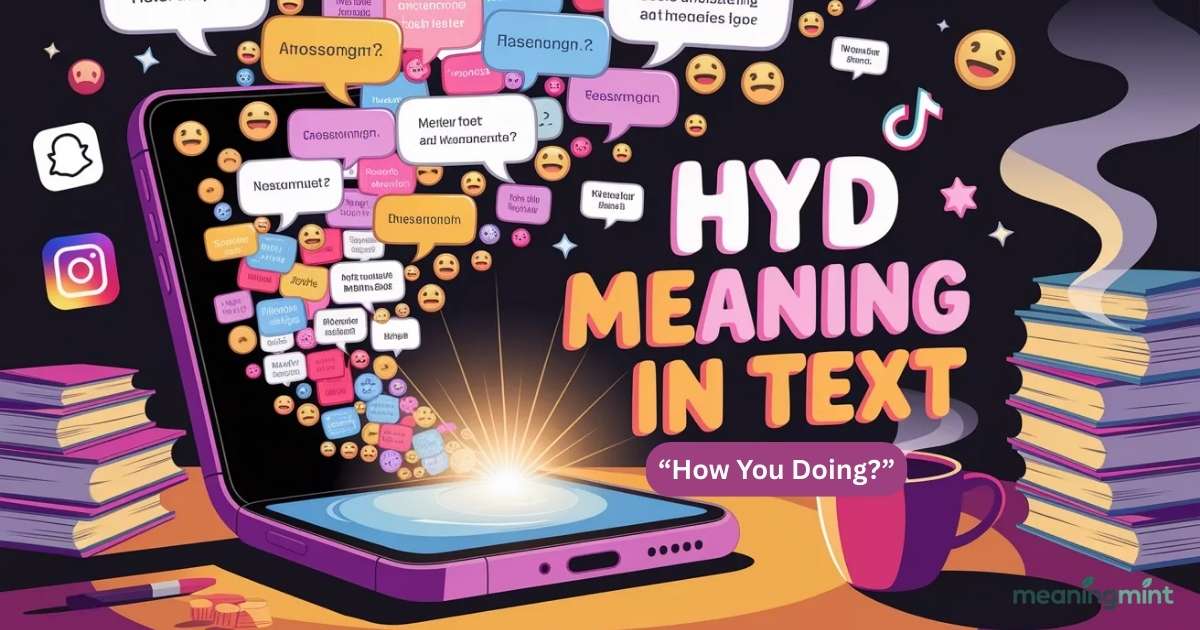
Hyd meaning in text usually stands for “How You Doing?” It’s a casual way to ask someone about their mood, day, or current situation. People use it in messages, chats, or social media to start a conversation quickly and informally.
Examples:
- “HYD today?”
- “Hey, HYD?”
- “Long time no see, HYD?”
Similar Abbreviations:
| Abbreviation | Meaning | Usage Example |
| WYD | What You Doing? | “WYD tonight?” |
| HBU | How ‘Bout You? | “I’m good, HBU?” |
| SUP | What’s Up? | “Sup bro?” |
ALSO READ: What Does IG Meaning in Text? Full Form, Meanings & Examples 2026
A Bit of History
Text abbreviations like HYD grew popular with SMS and instant messaging in the early 2000s. Typing shortcuts helped save time and character limits, especially on early mobile phones. Over time, social media platforms further spread these casual texting trends worldwide.
Examples:
- Early MSN Messenger chats often used HYD.
- SMS messages with 160-character limits encouraged short forms.
- Teenagers and young adults adopted it first.
Timeline Table:
| Year | Milestone |
| 1990s | SMS becomes widely used |
| 2000 | Instant messaging shortcuts grow |
| 2010 | Social media spreads abbreviations |
Why Understanding HYD Is Important
Knowing HYD or hyd meaning in text helps avoid confusion in digital conversations. It ensures smooth communication and prevents misinterpretations. For businesses, influencers, or casual texters, recognizing such slang improves engagement, tone, and relatability, especially with younger audiences who frequently use informal abbreviations.
Examples:
- Replying correctly in chat: “I’m good, HYD?”
- Texting coworkers informally (if appropriate)
- Understanding social media comments
Tips:
- Always consider context.
- Avoid overusing abbreviations in professional chats.
- Learn common slang to stay updated.
When and Where HYD Is Commonly Used
HYD appears mostly in casual digital spaces like text messages, WhatsApp, Instagram DMs, Snapchat, and TikTok comments. It’s informal and friendly, often used among friends, peers, or young adults initiating conversations without being too formal.
Examples:
- Chatting with friends: “HYD? Haven’t talked in weeks!”
- Commenting on a TikTok video: “HYD? That dance is amazing.”
- Messaging a classmate: “HYD today? Ready for the exam?”
Tone Matters: Interpreting HYD Based on Context
The hyd meaning in text can shift depending on who’s texting and the situation. While it generally means “How You Doing?”, tone, emojis, or surrounding messages often clarify whether it’s casual, flirtatious, professional, or just a passive check-in, helping avoid misunderstandings.
- Consider relationship with sender.
- Look at accompanying emojis or punctuation.
- Context of previous messages matters.
Friendly Check-In
When friends use HYD, it’s usually a warm, casual greeting. It shows interest in someone’s well-being without pressure. Often paired with emojis or small talk, it’s a simple way to stay connected, maintain friendships, and check on someone’s day in a relaxed manner.
Examples:
- “HYD 😊? Missed you yesterday!”
- “Hey, HYD? Long time no chat.”
- “HYD? Want to grab coffee later?”
- Common among close friends
- Often followed by casual conversation
- Emojis can emphasize friendliness
Flirtatious
Sometimes, HYD carries a playful or flirty tone. This usually appears with heart, wink, or cheeky emojis. The intent is to show interest while keeping the message light and engaging, often sparking flirtatious banter or deeper conversation.
Examples:
- “HYD 😉? Thinking about you.”
- “Hey, HYD 😏? You’ve been on my mind.”
- “HYD 😘? Can’t wait to see you.”
- Watch for emoji cues
- Timing matters—usually personal chats
- Tone feels light, teasing, or playful
Professional (Very Rare)
Using HYD or hyd meaning in text in professional settings is uncommon and may seem overly casual. It can be used informally among colleagues or teams familiar with each other. In formal communication, full phrases like “How are you doing?” are preferred to maintain professionalism.
Examples:
- “HYD with the project update?” (informal team chat)
- “HYD? Ready for the meeting?” (friendly office message)
- Rare in corporate emails
- Acceptable only among familiar coworkers
- Emojis usually avoided
Passive Check-In
Sometimes, HYD is just a minimal, low-effort check-in. It’s often used when someone wants to acknowledge another person without initiating a long conversation. The tone is neutral, showing mild interest without expecting detailed responses.
Examples:
- “HYD?” (sent alone)
- “HYD? Just passing by.”
- “HYD… haven’t heard from you in a while.”
- Minimal engagement
- No extra context or emojis
- Neutral or slightly distant tone
How to Reply to HYD Based on the Situation
Replying to HYD or hyd meaning in text depends on context, relationship, and tone. A friendly HYD deserves a casual response, a flirtatious HYD can be playful, a professional HYD should be polite, and a passive HYD can get a simple acknowledgment. Matching tone ensures smooth communication.
Examples:
- Friendly: “I’m good! HYD with you?”
- Flirtatious: “Better now that you asked 😉. HYD?”
- Professional: “I’m doing well, thank you. HYD with your project?”
- Passive: “I’m fine, thanks. HYD?”
- Always consider tone and relationship
- Keep responses appropriate for context
- Emojis help convey friendliness or playfulness
Framework for Responding
A simple framework helps reply to HYD effectively: Acknowledge → Mirror → Engage → Optional Question. First, acknowledge the greeting, mirror their tone, engage with a small update, and optionally ask a follow-up to continue conversation naturally.
Example flow:
- Acknowledge: “Hey! Great to hear from you.”
- Mirror: “I’m doing well too 😊.”
- Engage: “Busy with work, but enjoying it.”
- Optional Question: “HYD with your weekend plans?”
- Keeps conversation balanced
- Avoids one-word replies
- Shows interest without overthinking
What to Avoid
When replying to HYD, avoid ignoring tone, sending one-word answers, or overcomplicating the response. Misreading context can create awkwardness, especially in flirtatious or professional messages. Simplicity and relevance maintain clarity and prevent miscommunication.
Examples of poor replies:
- “Ok” (too short)
- “Fine” (blunt, no engagement)
- “What do you mean?” (if tone was casual/friendly)
- Avoid mismatched tone
- Don’t ignore emojis or context
- Keep it concise but engaging
15 Ideal Replies to “HYD” (With Context and Tone Explained)
Replying to HYD effectively depends on the relationship, tone, and situation. Choosing the right response ensures your conversation flows naturally, whether it’s friendly, flirtatious, professional, or casual. Here are 15 ideal replies, organized by context and tone.
Friendly Replies
Friendly HYD responses are casual, warm, and show interest without pressure. Emojis or small talk can make the reply feel welcoming.
Examples:
- “I’m good! HYD with you?” – Simple, mirrors tone.
- “Hey! Doing well, what about you?” – Keeps conversation flowing.
- “All good here 😊 HYD?” – Friendly with an emoji touch.
- Works best with friends or peers
- Encourages further conversation
- Feels natural and approachable
Flirtatious Replies
Flirtatious replies add a playful or teasing tone, often with winks, hearts, or emojis. They indicate interest and spark light, fun conversation.
Examples:
4. “Better now that you asked 😉. HYD?” – Playful and teasing.
5. “Hey you 😏 I’m great, HYD?” – Suggestive, casual.
6. “Can’t complain 😘 HYD with my favorite person?” – Fun, affectionate tone.
- Use with people you know well
- Emojis emphasize flirtiness
- Avoid overdoing in professional contexts
Polite/Professional Replies
Professional replies are respectful, neutral, and concise. Perfect for work chats or formal situations where friendliness is okay but casual slang is limited.
Examples:
7. “I’m doing well, thank you. HYD with your project?” – Polite and context-aware.
8. “Good, thanks! How’s your day going?” – Neutral and friendly.
9. “I’m fine, thank you for asking. HYD?” – Formal and safe.
- Avoid emojis or overly casual language
- Keep responses concise but polite
- Suitable for colleagues or new professional contacts
Honest/Relatable Replies
Honest replies convey genuine feelings, even if not perfect. They build trust and relatability, showing you’re real rather than just polite.
Examples:
10. “Honestly, a bit tired 😅 HYD?” – Casual, honest, relatable.
11. “I’ve had a long day, but surviving! HYD?” – Shares personal state lightly.
12. “Feeling good, but busy. HYD?” – Simple and truthful.
- Works in friendly or informal contexts
- Helps maintain authenticity
- Avoid oversharing in professional chats
Energetic/Positive Replies
Energetic replies show excitement, positivity, and enthusiasm. They are uplifting and make the conversation feel lively.
Examples:
13. “I’m amazing today 😎 HYD?” – High-energy and fun.
14. “Feeling fantastic! How about you?” – Positive and engaging.
15. “Can’t stop smiling 😁 HYD?” – Enthusiastic and cheerful.
- Use with friends or peers
- Emphasizes good mood and energy
- Emojis enhance positivity
Casual vs Polite vs Professional Responses: Know the Difference
How you reply to HYD depends on context, relationship, and tone. Casual responses are friendly and relaxed, polite responses show courtesy, while professional responses are neutral, concise, and formal. Choosing the right style avoids misunderstandings and ensures your message fits the situation.
Examples:
| Response Type | Example Reply | When to Use | Tone Notes |
| Casual | “Hey! I’m good 😄 HYD?” | Friends, peers, social chats | Friendly, informal, approachable |
| Polite | “I’m doing well, thank you. HYD with you?” | Acquaintances, semi-formal chats | Courteous, respectful, neutral |
| Professional | “I’m fine, thank you. HYD with your project?” | Work chats, colleagues, formal settings | Neutral, concise, professional |
Alternatives to HYD – Say It Better
Instead of using HYD, you can vary your greetings to match tone, relationship, and context. Choosing the right alternative keeps your conversations fresh, avoids repetition, and expresses care, friendliness, or professionalism more effectively, depending on the situation.
Polite
Polite alternatives show courtesy without being overly casual. They’re suitable for acquaintances, formal texts, or semi-professional chats.
Examples:
- “How are you today?”
- “I hope you’re doing well.”
- “Hope all is going smoothly with you.”
- Neutral tone, shows consideration
- Works with acquaintances or semi-formal contexts
- Avoid emojis for formal impression
Casual
Casual alternatives are relaxed, simple, and friendly, perfect for peers or social chats. They maintain approachability without requiring formality.
Examples:
- “What’s up?”
- “How’s it going?”
- “How are things with you?”
- Short and approachable
- Can include emojis for warmth
- Great for friends or social groups
Friendly/Personal
Friendly or personal alternatives convey warmth, closeness, and genuine interest. They’re ideal for friends, family, or people you know well.
Examples:
- “Hey! How’s your day going?”
- “Missed you! How are you?”
- “How’s everything with you today?”
- Shows care and engagement
- Often paired with emojis
- Encourages extended conversation
Professional
Professional alternatives are polite, neutral, and concise, fitting workplace or formal communication. They maintain clarity without casual slang.
Examples:
- “How are you doing today?”
- “I hope your day is going well.”
- “How is your project coming along?”
- Clear and formal
- Avoid slang or emojis
- Best for colleagues, clients, or business contacts
Choosing the Best Reply: Key Factors
Choosing the best reply to HYD depends on tone, relationship, and context. Consider the sender’s intent, your relationship, and the platform. Matching tone—friendly, flirtatious, professional, or casual—ensures your response feels appropriate and keeps the conversation flowing naturally.
Factors to Consider:
- Relationship type (friend, colleague, acquaintance)
- Tone of the original message (casual, flirty, neutral)
- Platform (social media, texting, work chat)
- Emojis and context cues
Example Replies by Context:
- Friendly: “I’m good! HYD with you?”
- Flirtatious: “Better now that you asked 😉 HYD?”
- Professional: “I’m fine, thank you. HYD with your project?”
Common Mistakes to Avoid
Responding to HYD can be tricky if you ignore tone or context. Avoid one-word replies, mismatched tone, overuse of slang, or ignoring professional etiquette. Misreading the message can create awkwardness or confusion, so simplicity and relevance are key.
Mistakes to Avoid:
- Replying “Ok” or “Fine” (too short)
- Using casual slang in professional chats
- Ignoring emojis or playful tone
- Overcomplicating the response
Better Approach:
- Match tone and context
- Keep replies concise but engaging
- Use emojis when appropriate for casual or friendly chats
Case Studies: Real Conversations Using HYD
Understanding how HYD works in real conversations helps you respond naturally. By examining different contexts—friendly, flirtatious, and professional—you can see how tone, emojis, and phrasing affect meaning, engagement, and relationship dynamics in texting or social media chats.
Example 1 – Friendly Check-In
A friendly HYD is casual, warm, and invites small talk without pressure. It shows genuine interest in someone’s day or mood, often paired with an emoji or casual greeting to make the conversation feel natural and approachable.
Conversation Example:
- Alex: “HYD today? 😊”
- Jordan: “I’m good! Just finished my workout. HYD with you?”
- Alex: “Same here! Been busy, but all good.”
- Shows care and engagement
- Encourages back-and-forth conversation
- Emoji adds friendliness
Example 2 – Flirtatious Version
A flirtatious HYD conveys playfulness or mild teasing. It often includes winks, hearts, or cheeky emojis to signal interest while keeping the tone light. Timing, relationship, and context are key to avoid misunderstandings.
Conversation Example:
- Sam: “HYD 😉?”
- Riley: “Much better now that you asked 😏. HYD with my favorite person?”
- Sam: “Haha, I’m smiling 😘. Doing great, thanks!”
- Emoji cues emphasize flirtation
- Light teasing builds engagement
- Best used with mutual comfort
Example 3 – Workplace/Professional Setting
Professional hyd meaning in text or HYD is neutral, polite, and concise. It’s rare in formal work communication but acceptable in team chats or when colleagues are familiar. The tone avoids slang, emojis, or overly casual language.
Conversation Example:
- Manager: “HYD with the new report?”
- Employee: “I’m doing well, thank you. The report is on track. HYD with your tasks?”
- Manager: “Thanks, everything is proceeding smoothly.”
- Polite and context-aware
- Avoids casual emojis or slang
- Keeps conversation professional and clear
The Evolution of “HYD” in 2026
In 2026, HYD or hyd meaning in text has evolved beyond SMS shortcuts to social media and messaging apps. It’s often paired with emojis, GIFs, or quick voice messages. While casual use dominates, younger users creatively mix it with slang, abbreviations, or playful variants like “HYDing?”
Trends in 2026:
- HYD + emojis or GIFs for expressive tone
- Variants like “HYDing?” or “HYD rn?”
- Popular in TikTok, Instagram DMs, and Snapchat
- Professional chats still favor full phrases
Conclusion
Understanding what does hyd mean in text and what does hyd mean on Snapchat or hyd meaning in text allows you to respond naturally in different conversations. Whether it’s a casual greeting, friendly check-in, or playful message, knowing hyd meaning or hyd meaning in text ensures your replies are appropriate, relevant, and engaging.
From Example 2 – Flirtatious Version to Example 3 – Workplace/Professional Setting, HYD adapts based on context and relationship. Using emojis adds friendliness, shows care and engagement, and encourages back-and-forth conversation. By 2025, HYD has evolved creatively across social media while still maintaining its role in meaningful, quick communication.
Frequently Asked Questions
How do you respond to HYD?
You respond based on context friendly, flirtatious, or professional matching tone, emojis, and relationship for a natural conversation flow.
What does HYD stand for in slang?
In slang, HYD stands for “How You Doing?”, a casual greeting used in texting or social media chats.
What is the short form of HYD?
The short form HYD is simply the abbreviation of “How You Doing?”, commonly used in casual messaging.
What Does HYD Meaning in Text?
hyd meaning in text “How You Doing?” It’s a casual greeting used in friendly text conversations online.
What does HYD mean from a girl?
From a girl, HYD or hyd meaning in text often indicates friendliness, flirtation, or casual interest, depending on emojis, tone, or context cues.
Can HYD be used professionally?
Yes, HYD or hyd meaning in text can appear in team chats, but formal messages prefer full phrases like “How are you doing today?”.
How do you reply to HYD from a friend?
Reply casually, show interest in their day, and use emojis to maintain friendliness and encourage back-and-forth conversation.
Is HYD considered flirtatious?
HYD can be flirtatious depending on tone, emojis, or context; playful winks, hearts, or teasing words often indicate interest.
What does HYD mean on Instagram?
On Instagram DMs or comments, HYD is a casual greeting used to start chats, often with emojis or GIFs.
Can you ignore a HYD message?
Technically yes, but ignoring HYD may seem rude; a polite or casual reply shows care and engagement with conversation.
What is the difference between HYD and HYB?
HYD asks “How You Doing?”; HYB asks “How You Been?” HYB references past days while HYD focuses on present.
How do you respond to a flirtatious HYD?
Mirror the playful tone with emojis, teasing words, or mild flirtation, ensuring comfort and mutual understanding during conversation.

Dome, creator of Meaningmint, turns everyday words into powerful meanings. His mission? Make knowledge refreshing, just like mint.