
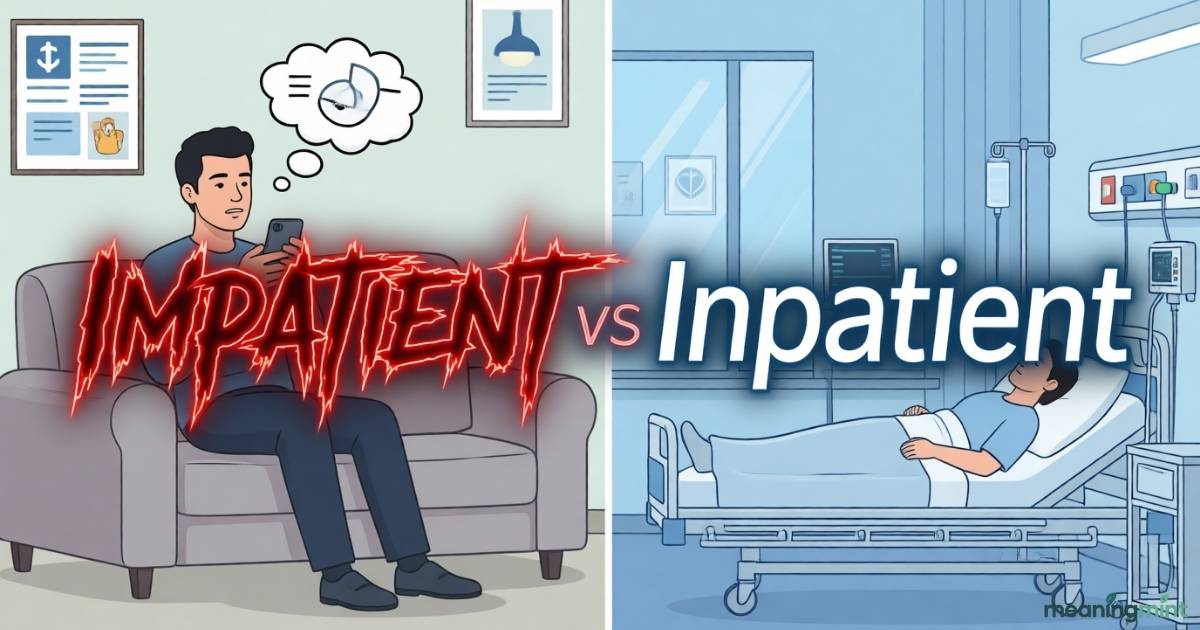
Understanding “impatient vs inpatient” is essential because although these words sound similar, they have very different meanings.
- Impatient: Feeling restless or annoyed due to delay or waiting.
- Inpatient: A person admitted to a hospital for overnight or long-term care.
This article will explain the impatient vs inpatient meanings, grammar, texting usage, common confusions, and examples of these terms to help you use them correctly.
What Does Impatient Mean in Text Messages?
In texting and online chat (WhatsApp, Instagram, TikTok, Snapchat), impatient usually refers to someone who is annoyed or eager for something to happen.
Examples in chat:
- “I’m so impatient waiting for the concert tickets 😩.”
- “Stop being impatient, they’ll reply soon.”
Here, it conveys frustration, urgency, or excitement.
Slang meaning:
- Impatient is informal in online chat.
- It’s not an acronym; it’s a normal English word often used in casual conversation.
Usage on social media:
- Snapchat: “He’s so impatient, sending 5 snaps in a row 😅.”
- TikTok: Used in captions like: “Me being impatient while my food delivery arrives 🍕.”
What Does Inpatient Mean in Text Messages?
Inpatient, on the other hand, is mostly used in formal or medical contexts.
Examples in chat:
- “Grandma is an inpatient at City Hospital, so I’ll visit tomorrow.”
- “The doctor said he must remain inpatient for a week for observation.”
Slang meaning:
- Inpatient doesn’t have a slang meaning; it’s a formal term.
- Mostly used in hospital or healthcare contexts.
Usage on social media:
- Instagram: “Sending love to all my friends who are inpatients recovering 💖.”
- WhatsApp: Shared in health updates or family group messages.
Grammar Role of Impatient and Inpatient
| Word | Part of Speech | Sentence Position | Tone |
| Impatient | Adjective | Before a noun or after linking verbs (am, is, are) | Informal to neutral |
| Inpatient | Noun / Adjective | Noun: subject or object; Adjective: before noun | Formal / neutral |
Examples:
- Adjective: “She’s impatient about the exam results.”
- Noun: “He is an inpatient at the city hospital.”
- Adjective: “The inpatient care department is very efficient.”
Key Differences Between Impatient and Inpatient
| Feature | Impatient | Inpatient |
| Meaning | Restless or eager | Hospitalized for care |
| Part of Speech | Adjective | Noun / Adjective |
| Usage | Casual, informal, everyday situations | Formal, medical, healthcare |
| Texting | Common in chats, social media, slang contexts | Rare, only in medical updates or serious contexts |
| Tone | Informal to neutral | Neutral to formal |
| Example | “I’m impatient to get my results.” | “She is an inpatient undergoing treatment.” |
ALSO READ: CMP Meaning in Text: What It Really Means in 2026
Who Commonly Uses These Terms?
- Impatient:
- Teens, young adults, social media users
- Platforms: WhatsApp, Instagram, TikTok, Snapchat
- Regions: Worldwide
- Teens, young adults, social media users
- Inpatient:
- Healthcare professionals, patients, families
- Platforms: WhatsApp groups, hospital communication apps
- Regions: Mostly English-speaking countries in formal healthcare discussions
- Healthcare professionals, patients, families
Texting and Online Chat Examples
Here are real-life examples to show the difference:
Impatient
- “I’m impatient waiting for your reply 😤.”
- “Can’t wait! I’m too impatient for the movie night 🎬.”
- “Stop being so impatient, the food is coming 🍔.”
Inpatient
- “He’s been an inpatient at St. Mary’s Hospital since Monday.”
- “The inpatient procedure requires overnight monitoring.”
- “Visiting my friend, she’s an inpatient, so I’ll bring some flowers 🌸.”
Common Confusions: Impatient vs Inpatient
Many people mix these two because they sound similar. Remember:
- Impatient → emotion, feeling annoyed or eager.
- Inpatient → person in a hospital, or hospital care type.
Tips to remember:
- “Impatient” has an extra “t” for temper” → shows frustration.
- “Inpatient” → “in” a hospital → medical context.
Experience-Based Insight
In everyday conversations, impatient is far more common than inpatient because people often express impatience in texting, commenting, or chatting. For example:
- Teens texting: “OMG I’m so impatient for the new season of Stranger Things!”
- Adults on social media: “Can’t believe how impatient I was waiting for my order.”
Inpatient is mostly restricted to health updates, medical reports, or formal contexts, rarely appearing in casual conversation.
Related Variations
- Impatient meaning in text → refers to restlessness in messages.
- Inpatient meaning in chat → a formal reference to someone hospitalized.
- Impatient slang meaning → expressing frustration or eagerness online.
- Inpatient slang meaning → rarely exists; mostly formal.
- Impatient meaning on Snapchat → shown in stories, snaps, or captions.
Usage Tips
- Use impatient in casual conversation when expressing eagerness or frustration.
- Use inpatient only in formal or medical contexts.
- Double-check spelling: “impatient” for emotions, “inpatient” for hospitals.
- Avoid mixing them; context usually clarifies the meaning.
- Combine impatient with emojis in texting to express emotion clearly.
Summary
- Impatient = feeling restless, eager, or frustrated; informal and widely used in chat.
- Inpatient = a person admitted to a hospital or care facility; formal and medical.
- Both words sound similar but are used in entirely different contexts.
- Remember: “impatient” = emotion; “inpatient” = medical stay.
- Texting and social media often see impatient in action, while inpatient stays confined to healthcare discussions.
Using these tips, you’ll avoid confusion and sound more confident in both impatient vs inpatient writing and texting.
Conclusion:
Understanding the difference between impatient and inpatient is essential for clear communication. Impatient reflects emotions like eagerness or frustration, commonly used in texting, social media, and casual chats. Inpatient, however, is formal, referring to someone admitted to a hospital for care.
Using these words correctly improves both written and spoken communication. Remember: impatient = restlessness or urgency, inpatient = hospital context. Pay attention to spelling and context to avoid confusion. In real conversations, impatient appears frequently online, while inpatient is mostly used in medical discussions.
Frequently Asked Question
What is the difference between impatient and inpatient?
Impatient = restless or eager; inpatient = someone admitted to a hospital.
What does impatient mean in chat?
In chat, it shows frustration, excitement, or urgency waiting for something.
Can inpatient be used informally?
Rarely. Inpatient is mostly formal, used in healthcare or hospital contexts.
How do you remember impatient vs inpatient?
Impatient = emotional frustration; Inpatient = in hospital (medical).
Who uses the word impatient most online?
Teens, young adults, social media users on TikTok, Instagram, WhatsApp, and Snapchat.
Is impatient considered rude in text messages?
Not necessarily. It expresses eagerness or frustration but can sound rude if overused or aggressive.
Can inpatient be used outside medical contexts?
Rarely. “Inpatient” is mostly formal and medical; using it elsewhere may confuse readers.

Dome, creator of Meaningmint, turns everyday words into powerful meanings. His mission? Make knowledge refreshing, just like mint.